Menu
Home Calligraphy Trip to Beijing Focus on Japan Zen Belleza Odiada ConnectedGlobe
To see this page in your own language use the following translation bar.
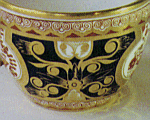
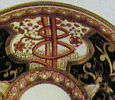
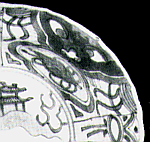 Here is a mystery. The mask appearing in the Spode porcelain looks more stylised and similar to
the Chinese prototype taotie mask than that of KRAAK porcelains.
I wonder if the Spode craftsman was conscious about depicting the mask (pattern) when he was
decorating the cup and saucer. It seems unlikely. He would probably have no way of knowing of
such a pattern which carries a heritage of thousands of years of history.
Here is a mystery. The mask appearing in the Spode porcelain looks more stylised and similar to
the Chinese prototype taotie mask than that of KRAAK porcelains.
I wonder if the Spode craftsman was conscious about depicting the mask (pattern) when he was
decorating the cup and saucer. It seems unlikely. He would probably have no way of knowing of
such a pattern which carries a heritage of thousands of years of history.
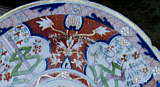 When I saw the identical part of another example of Spode porcelain depicting the "Dollar Pattern",
I came to the conclusion that they were unaware of the fact that the configuration of each ornamental detail
could be making an image of a mask here.
When I saw the identical part of another example of Spode porcelain depicting the "Dollar Pattern",
I came to the conclusion that they were unaware of the fact that the configuration of each ornamental detail
could be making an image of a mask here.
Ernst Gombrich has written in The Sense of Order (P.210) that ... Nothing comes out of nothing. The great ornamental styles could no more have been the invention of one man, however inspired, than could the organ fugue... it is much easier to modify, enrich or reduce a given complex configuration than to construct one in void. Hence certain formal sequences resemble the game of cat's cradle, with every craftsman taking over the threads from the hands of his predecessor and giving them an extra twist.
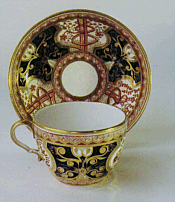
We have no way of knowing how the Spode craftsman created this image. We know he would have copied from Chinese or Japanese samples. However, we will never know if he copied directly by holding the sample in his hand, or copied from an image in his memory. Also we will never know whether there were several stages of copying from one sample to another. All we know is the existing fact of the pattern in Spode Porcelain and some samples of Chinese and Japanese KRAAK porcelain which might have influenced it. There is the void of mystery in the gap between, which only gives us an opportunity for the pleasure of using our imagination. This is the romance of the migration of images.

© 2019 Graham G Hawker
Privacy Policy